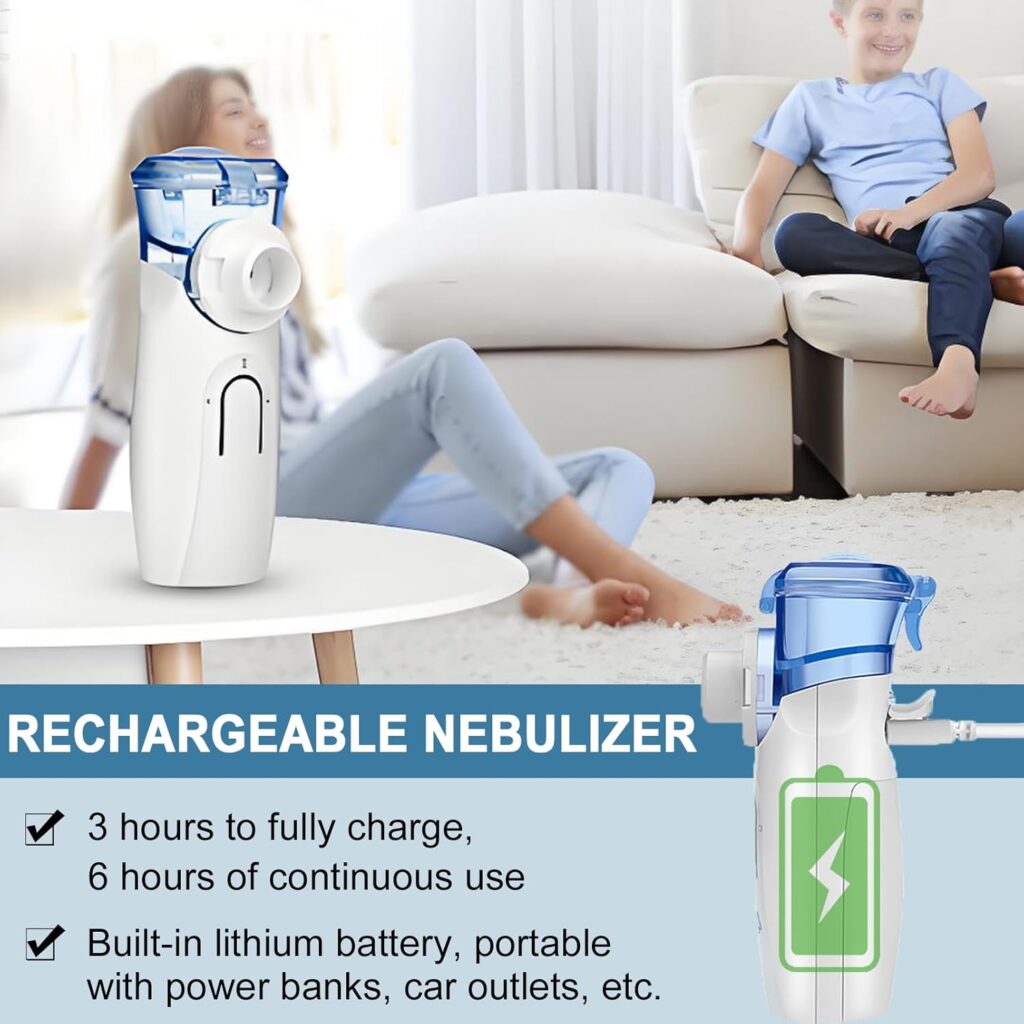

Do you want a small, discreet way to take your respiratory meds that doesn’t announce itself with a droning compressor sound?

This image is property of Amazon.com.

Quick look at the Gülife Ultrasonic Nebulizer, Portable Nebulizer Machine with Two Power Mode, Gray
You already know what you need from a nebulizer: portability, reliability, and a mist that actually reaches the parts of your lungs that matter. The Gülife Ultrasonic Nebulizer promises a quiet, compact experience with a clear focus on travel-friendly power options and simple status LEDs. In plain terms: it’s meant to let you treat symptoms without turning your living room into a clinic.
You’ll find this is a machine that emphasizes convenience over gadgetry. It doesn’t have an app, it doesn’t sync to your watch, it simply does one job quietly and offers a few indicators so you know what’s happening.
Design and first impressions
The gray finish is intentionally unshowy, which suits you if you prefer your medical devices to blend into a bag rather than sing for attention. The unit is lightweight and compact, the kind of object you drop into a carry-on and forget about until you need it.
When you hold it, you notice the restraint: no oversized buttons, no excessive plastic trim, and a small reservoir that speaks to short sessions rather than prolonged, clinic-style treatments. It’s modest by design, and that modesty is part of its appeal.
Technical breakdown
You want specific numbers because they tell you what to expect. This section gives you the measurements the nebulizer uses to make its case, and what those numbers mean in practice.
| Feature | Specification | What it means for you |
|---|---|---|
| Medicine capacity | Up to 8 ml | Enough for single-session doses or a couple of short sessions; not for large-volume treatments |
| Nebulization rate | ≥ 0.25 ml/min | Expect roughly 30+ minutes for a full 8 ml session at the slowest stated rate; rate may be faster |
| Particle size | < 5 μm | Small particles that can reach lower airways — useful for many inhaled medications |
| LED indicators | Blue (operation), Orange (solution depletion), Red (low battery), Alternating Blue/Orange/Red (self-clean) | Clear visual signals so you know condition at a glance |
| Power modes | 2x AA alkaline batteries or AC power (plug-in) — not rechargeable | Flexibility for travel or home use; bring batteries for on-the-go |
| Noise level | < 25 dB | Very quiet — comparable to a whisper or rustling paper |
| Color | Gray | Unobtrusive, neutral aesthetic |
You can use this table as a quick reference when you’re deciding whether this unit fits your lifestyle. If you travel or dislike noisy devices, these specs likely appeal to you.
This image is property of Amazon.com.

Performance in real use
Numbers are one thing; actual experience is another. When you use the Gülife, the first thing you notice is the silence. Under 25 dB means it won’t drown out your phone calls or your ability to read in the same room, which is nicer than it sounds if you’re trying to keep a routine without disruption.
The nebulization rate listed as ≥0.25 ml/min is conservative. If you fill it with 8 ml, then at that minimum rate you’re looking at roughly 32 minutes of continuous nebulization. That’s long enough to be thorough but short enough to slot into a break or commute when you must. Keep in mind the rate can vary with the solution you use and how full the reservoir is.
Particle size under 5 μm is meaningful. That size range helps deliver medication deeper into the lungs, which matters if you’re treating lower airway conditions. You won’t always need that penetration — for upper-airway saline or humidification, larger particles are fine — but it’s reassuring when your meds need to go further.
Mist quality and comfort
The mist is fine and smooth, not like a spray bottle but more like a light fog. That matters because some nebulizers produce coarse droplets that feel abrasive or settle quickly on your face; this one feels even and consistent.
Because the particle size is small, you’ll often feel the treatment mostly in the back of your throat and chest rather than all over your face, which can feel more effective and less wasteful. If you have a sensitive gag reflex, you may notice less provocation than with coarser systems.
Power options and what they mean for your life

A Simple Technique People Use Before Bed
A short routine designed to help your body relax and unwind naturally.
- ✔ Easy to learn and takes only a few minutes
- ✔ No equipment or supplements required
- ✔ Popular among people struggling to relax at night
You’ll appreciate the dual power modes: two AA alkaline batteries when you need to be untethered, or plug in when you’re at home. It is not rechargeable, so if you prefer devices with internal batteries and USB charging, this isn’t that device.
Bring spare AA batteries if you travel. The device is designed to be portable, but portability is only useful if you remember to power it. Alkaline AA cells are easy to buy and replace, and they make the unit truly travel-ready — no bulky external battery pack required.
Battery-etiquette and practical tips
If you use the battery option, check the LED regularly. The red LED indicates low battery; don’t wait until it blinks mid-session or you’ll be halfway through treatment and forced to stop. If you rely on plug-in power at home, keep a small power strip near your bedside or chair so you don’t have to crawl behind the couch when you need it.
Because it’s not rechargeable, plan for backups. Everyone has a moment when the AA stash is gone, and that’s when a plugged-in option shines. You can also keep one set of batteries in your travel bag and another at home to simplify logistics.

This image is property of Amazon.com.
LED indicators and the self-clean mode
The LED set is straightforward and, in a field where ambiguity is common, refreshingly readable. Blue shows operation, orange tells you the solution is depleted, and red points to low battery. The alternating blue/orange/red pattern is used to signal the self-clean mode.
That self-clean mode is a nice nod toward convenience. It suggests the manufacturer understands you won’t always want to disassemble every component at the end of a session. The alternating LED pattern is a clear visual clue that the unit is in a cleaning cycle, and it’s easy to understand without a manual.
How you’ll interpret the lights mid-session
You’ll learn quickly: solid blue = go, solid orange = nearly done with solution, red = get batteries or plug in. The alternating pattern for self-clean is visually distinct, so if it flashes that way after you finish, you’ll know it’s doing a routine its maker thinks helpful.
These signals cut down on guesswork. You don’t have to stare at the device to determine whether it’s working or whether it needs attention — the lights do that for you.
Noise level and discretion
Quiet operation under 25 dB is a headline feature. For perspective, 25 dB is roughly the volume of a whisper or a quiet library. That means you can use the Gülife in a shared living space, on an airplane (consult airline rules), or in a hotel room without making a scene.
This is a meaningful advantage if you often need treatments in public or semi-public spaces, because noisy compressors have a way of announcing maladies you’d prefer to keep private.
Practical scenarios where low noise matters
If you’re treating children who need to sleep afterward, a quiet nebulizer preserves the calm. If you’re on the commute and trying to read or catch up on email, it won’t be intrusive. The noise factor alone makes the device viable for many more contexts than a standard, vocal compressor.

This image is property of Amazon.com.
Portability and travel considerations
It’s compact and lightweight, and it feels like a device designed to fit into your daily life rather than dominate it. Its travel profile is stronger than many at-home compressors; it doesn’t need a bulky transformer or special batteries.
But don’t assume “portable” equals “hands-off.” Check airport and airline policies about medical devices before flying. Keep your prescription or instructions from your clinician handy if you’re traveling internationally. The device itself is small enough to tuck into a personal item, and the AA battery option makes it one of the few nebulizers you can truly use without access to plug points.
Packing tips
Pack spare batteries and small zip-lock bags for the mouthpiece and any masks to keep them clean. Keep your medication in original packaging with labeling if you’re on a plane. If you plan to use it on the go, a small travel case or pouch will save you time and frustration.
Cleaning and maintenance
Self-clean mode is helpful, but you’ll still need to handle basic care. Rinse the medication reservoir after each use and let components that contact medication air-dry. Avoid submersing electrical components or the base unit in water.
You don’t need a PhD in device hygiene, but you do need to respect the difference between the parts that can be washed and the parts that can’t. Regular cleaning prevents crusty residue, ensures better mist quality, and avoids the smell that comes from neglected nebulizers.
Recommended routine (practical and simple)
- After each session: empty leftover solution, rinse the reservoir with warm water, and let it air-dry on a clean towel.
- Weekly: disinfect removable components as recommended by your pharmacist (often using diluted vinegar or a mild disinfectant), but never put the whole machine in liquid.
- Always: check seals and connections for wear. If you notice cracks or persistent residue, replace the part or contact the seller.
These steps are common sense but easily forgotten. Keep a small checklist near the device for the first few weeks and it will become habit.

This image is property of Amazon.com.
Medication compatibility and clinical considerations
Ultrasonic nebulizers, like this one, are effective for many solutions, but not all. Certain suspensions, strong viscous formulations, or medication types may not nebulize optimally with ultrasonic technology. That’s not a flaw in the Gülife so much as a general caveat about the technology.
You should confirm with your prescribing clinician or pharmacist that your medication is suitable for ultrasonic nebulization. Many bronchodilators, saline, and other inhalation therapies are fine, but check before substituting this device for a clinic compressor that your provider prefers.
A word about heat-sensitive medications
Ultrasonic nebulizers can introduce slight warming into the solution. While for many meds this is negligible, for heat-sensitive compounds you’ll want confirmation from your healthcare provider. Err on the side of caution and verify compatibility rather than presuming all inhaled medications are interchangeable across devices.
Who should consider this device?
If you need portability, quiet operation, and a reliable mist for occasional or frequent use, this unit is worth your attention. It’s particularly well-suited to:
- Travelers who need on-the-go treatments.
- People who value discretion and low noise.
- Households who want a simple, no-frills nebulizer with clear status lights.
It may be less suited if you need long, high-volume sessions or if your medication explicitly requires a compressor or jet nebulizer. If you rely on a clinic-grade compressor for heavy-duty treatment multiple times per day, this may not replace that system.
Caregivers and parents
For caregivers, the quiet operation and compact size make it easier to manage a child’s treatment without turning the room into an operating theater. That said, children often need distraction and reassurance — the device’s modest aesthetics won’t do that for you, so bring a book or a tablet if you’re trying to keep a young patient still.
Pros and cons
You like clarity. Here’s an honest list so you can weigh your priorities.
Pros
- Quiet operation (<25 dB) for discreet treatments.
- Portable and lightweight for travel.
- Dual power modes (AA batteries or plug-in) for flexibility.
- Fine particle size (<5 μm) suitable for lower airway delivery.
- Simple LED indicator system for easy status checks.
- Self-clean mode adds convenience.
Cons
- Not rechargeable — you need fresh AA batteries or a plug.
- May not be suitable for all medication types; check compatibility.
- Smaller capacity (8 ml) means sessions are long but not for very high-volume needs.
- No advanced modes or app connectivity — it’s intentionally simple.
These pros and cons should help you decide whether convenience and silence beat the need for a more specialized or higher-capacity device.
Comparison with other nebulizer types
You’re comparing options: mesh, ultrasonic (this one), and compressor/jet nebulizers. Here’s how the Gülife stacks up in the broad strokes.
- Mesh nebulizers: Often battery-powered and portable, mesh devices push liquid through a fine mesh to create aerosol. They can be efficient and quiet. The Gülife uses ultrasonic tech, which can be similar in performance for many meds but behaves differently with viscous or suspended preparations.
- Compressor/jet nebulizers: These can handle a wider range of medications and higher volumes, which is why clinics still use them. They are noisier and bulkier than the Gülife.
- Ultrasonic: Quiet, good particle sizes, portable. Potential limitations with suspensions and certain formulations.
If you need clinical flexibility above all else, a compressor may still be preferable. If you need portability and discretion, the Gülife is a strong contender.
Practical tips for first-time users
When you first open the box and use the unit, do the following to avoid surprises:
- Read the quick start and double-check the LED meanings.
- Run a saline-only cycle to see how the mist feels and to test the lights.
- If using batteries, insert fresh alkaline AAs and keep a spare pair.
- Fill the reservoir to the recommended level — don’t overfill.
- If you experience unusual noises, stop and check that all parts are properly seated.
These small steps save you time and spare you the frustration of a half-session cut short by a missing battery or a misaligned reservoir.
Safety and warnings
You’re responsible for how you use medical devices, and manufacturers usually include disclaimers that are good to heed. Keep the unit away from children when not supervised, avoid submerging electronics, and follow medication instructions precisely.
If you see the red LED (low battery) in the middle of a session, stop and either plug in or replace batteries. If the orange LED shows solution depletion, top up as appropriate or end the session — continuing an empty reservoir can be damaging to the unit or produce inconsistent mist.
When to call a professional
If the device produces no mist despite solid blue LED, or if it heats significantly, stop using it and contact customer support. If your symptoms worsen or you feel lightheaded during use, discontinue use and consult a clinician immediately.
Frequently asked questions
You’ll likely have a few practical questions when deciding whether to buy.
Q: How long does a full 8 ml session take?
A: At the listed minimum nebulization rate (≥0.25 ml/min), expect roughly 32 minutes for 8 ml. Rates may be faster depending on conditions, so this is an estimate.
Q: Can you use it on a plane?
A: Airlines have varying policies. The device is small and battery-powered, but check with your carrier before flying. Bring documentation for prescriptions if possible.
Q: Is it suitable for pediatric use?
A: Many parents use small ultrasonic nebulizers for kids, but confirm medication suitability with your child’s clinician. Add an age-appropriate mask or mouthpiece as needed.
Q: Can it nebulize antibiotics or steroids?
A: Some medications work poorly with ultrasonic systems or are sensitive to heat. Check with your pharmacist or prescriber before using specific compounded or suspension medications.
Final verdict and recommendation
You want a device that won’t demand much from you and will quietly do its job when you need it. The Gülife Ultrasonic Nebulizer, Portable Nebulizer Machine with Two Power Mode, Gray is exactly that: low-profile, practical, and designed for real-life use rather than for flashing lights or complex settings. If portability, discretion, and a fine mist are your priorities, this is a wise choice.
It won’t replace a clinical compressor for heavy-duty, high-volume treatments, and it won’t replace the advice of your healthcare provider. But for personal, home, or travel use — when you want something that’s easy to carry, pleasantly quiet, and utterly unobtrusive — it’s a thoughtful, well-made option. If that’s what you need, it’s easy to recommend.
Closing practical checklist (so you don’t forget)
- Verify your medication is compatible with ultrasonic nebulization.
- Pack spare AA batteries if you intend to use it on the go.
- Rinse and dry the reservoir after each session.
- Keep an eye on the LEDs to avoid interruptions.
- Store in a small pouch to protect the mouthpiece and reservoir.
You’ll appreciate the simplicity once it becomes part of your routine. This unit is not trying to be clever; it’s trying to be useful — and for many people, that will matter more than any extra feature.

Disclosure: As an Amazon Associate, I earn from qualifying purchases.


